There are no items in your cart
Add More
Add More
| Item Details | Price | ||
|---|---|---|---|

A customer placed an order, clicked on COD, and when the order arrived, they returned it simply because THEY DID NOT WANT IT ANYMORE. This may sound like a simple return to the customer, but costs a fortune to the seller and that’s exactly what the biggest e commerce businesses try to avoid.
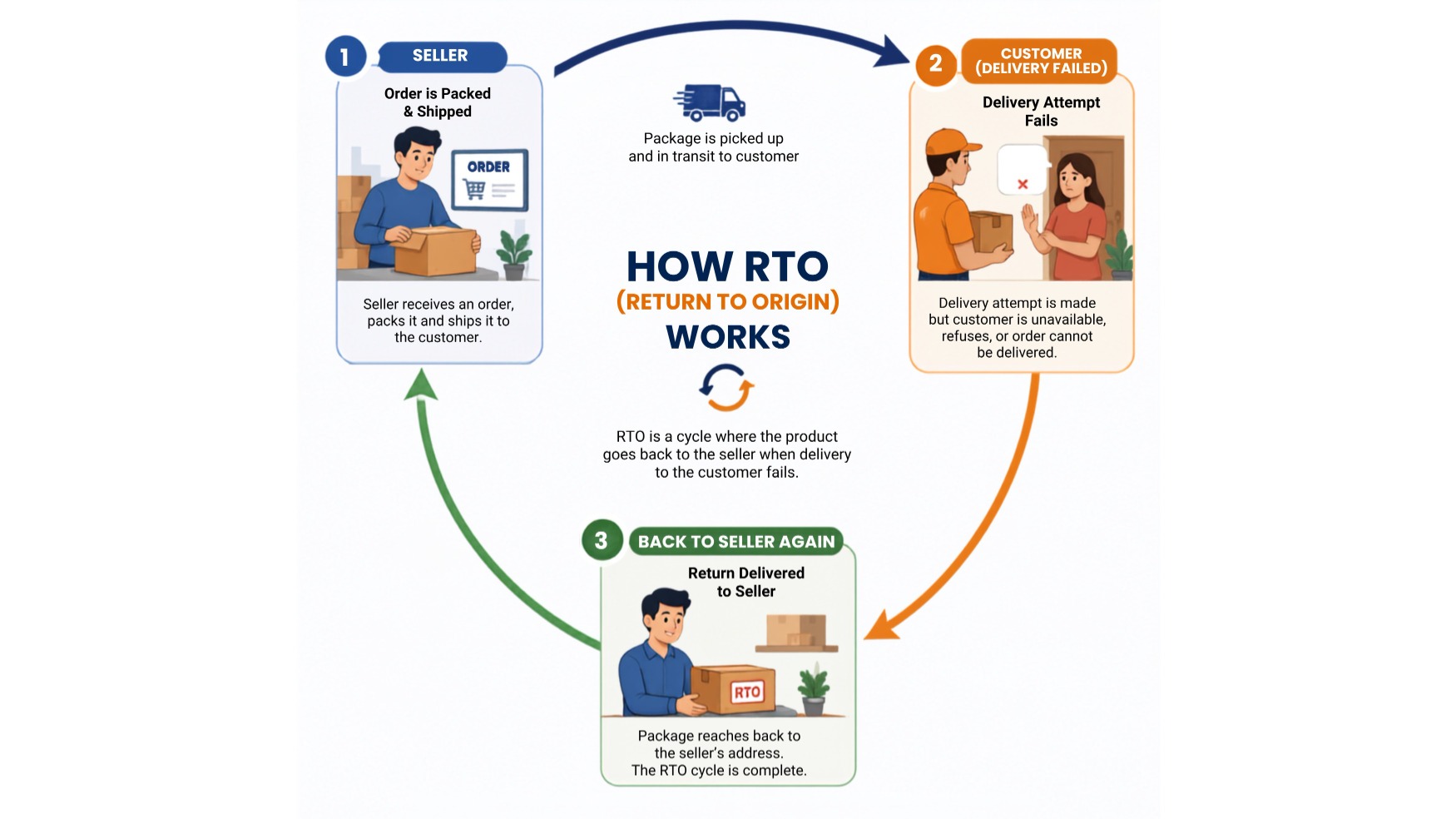
An undelivered package or product is sent back to the seller because the delivery couldn’t happen. That’s Return to Origin. Understand it this way-
Seller → Customer (delivery failed) →Back to the Seller again
The delivery fails maybe because the customer refused the order, provided the wrong address, is unavailable, or for several other reasons. In any case, the seller ends up paying for both forward and return shipping.
How is RTO calculated?
It’s no Algebra and Very simple to calculate.
Let’s say you get 100 orders in a month, and 25 of them return simply because they couldn’t be delivered, Your RTO rate becomes 25%. Here’s the formula you can use to do it for your business without too many complications-
RTO Rate = (Number of Returned Orders ÷ Total Orders) × 100
It’s that simple.
Let's say a seller owns an online clothing brand that sells T-shirts for ₹1,000. To fulfill one order, the seller spends
EXPENSE AMOUNT
| Cost of the T-shirt | ₹450 |
| Meta Ads | ₹250 |
| Packaging | ₹50 |
| Forward Shipping | ₹100 |
| Return Shipping (RTO) | ₹150 |
| Total Cost | ₹1,000 |
The customer refuses to accept the order, and the T-shirt is returned to the seller's warehouse, and the Profit is equal to what the seller spent which is Zero.
Remember, I am taking an approx price distribution for each because prices can differ based on the market economy.
Why RTO happens?
The delivery partner is waiting on the customer’s doorstep and they refuse to receive the product or do not pick up their calls is one of the 100 reasons behind Increased RTO rates.
I have listed the 6 biggest reasons amongst the several of Why does RTO actually happen.
1. COD orders - Many People order without being completely sure of the product, so they don’t want to pay right away and wait for the order to arrive to decide they don’t want it.
2. Customers changed their mind – The number of times I have heard people not accept their order simply because they changed their mind about it.
3. Wrong address – Incomplete or Incorrect Address – Address- 17th Street, Madhya Pradesh. I mean how is the delivery agent supposed to find your house at the 17th Street?
4. Customer Unavailable – Unavailable to receive their order or doesn’t answer calls.
5. Fake Orders – Someone trying to scam or ordered by mistake.
6. Delivery delays – With the availability of Quick Commerce, late deliveries are a setback to RTO because people will start looking elsewhere for the same product that can deliver faster.
Highest RTO States in India
Not every state in India has the same RTO rate, it differs majorly due to difference in Population Density, Demographic and Customer Buying Behaviour.
RTO rates differ for different niche or product types.
As per the data given by D2C brands and Ecommerce logistics-
Some specific states/ regions in India have higher RTO rates compared to others.
This doesn't mean people of those particular states are bad customers.
It simply means that, on an average, more orders from those locations are returned due to many reasons like-
1. BIHAR (25-35%)
Primary Reason- Very high COD dependency, fake/ incorrect orders, and address issues.
2. UTTAR PRADESH (20-30%)
Primary Reason- Orders in high volume, but refusal during delivery, and Slower deliveries in smaller cities and towns.
3. JHARKHAND (20-28%)
Primary Reason- failure in deliveries and longer shipping times.
4. WEST BENGAL (18-26%)
Primary Reason- COD refusals and delayed deliveries in some regions.
5. ASSAM (18-25%)
Primary Reason- Deliveries are delayed due to remote locations.
6. ODISHA (17-24%)
Primary Reason- Delivery delays in outskirt locations.
7. CHATTISGARH ( 17-24%)
Primary Location- Remote Location deliveries with limited courier reach.
8. MADHYA PRADESH (15-22%)
Primary Reason- Delivery in Rural Locations, and Incomplete Address.
9. RAJASTHAN (15-22%)
Primary Reason- Deliveries take more time because customers are spread across large areas.
10. PUNJAB (14-20%)
Primary Reason- Very high COD cancellations.
How Brands Can Reduce RTO?
RTO can be reduced with awareness of the listed things.
1. Encourage Prepaid Orders- Try Offering small discounts, cashbacks, or free shipping on prepaid orders. This will help in encouraging customers to pay in advance, making them less likely to refuse deliveries. 2. Verify COD Orders- Send an OTP, WhatsApp message, or confirmation call before dispatching COD orders. This will help reduce fake or accidental purchases before shipping.
3. Validate Customer Addresses- Use address verification tools like Smarty, GBG loqate during checkout to reduce failed deliveries caused due to incorrect or incomplete addresses.
4. Faster Delivery- The quicker a customer receives their order, the less likely they are to change their mind or buy the product elsewhere.
5. Identify High-Risk PIN Codes- Instead of blocking an entire state, analyse delivery performance at the PIN code level. If one particular area has consistent high RTO rates, you may disable COD only for that location continuing normal deliveries elsewhere.
6. Send Delivery Updates- Send Regular SMS, WhatsApp Messages, and email notifications to keep customers informed about their orders beforehand avoiding Delivery issues.
7. Use Reliable Courier Partners- Choosing the right logistics partner for specific regions can significantly improve delivery success rates.
High-RTO States Don't Mean Bad Customers
This is the biggest misconception
A state with a high RTO rate does not mean customers there are unreliable.
For example, Uttar Pradesh is one of India's largest ecommerce markets. It generates a very high number of orders. Even if a small percentage of those customers refuse deliveries, the total number of RTOs becomes significant.
Similarly, a state may have fewer overall orders but a higher percentage of returns due to logistics challenges or greater dependence on COD.
How to Track High-RTO States for Your Business?
Every ecommerce business has different RTO patterns depending on its products, customers, and courier partners.
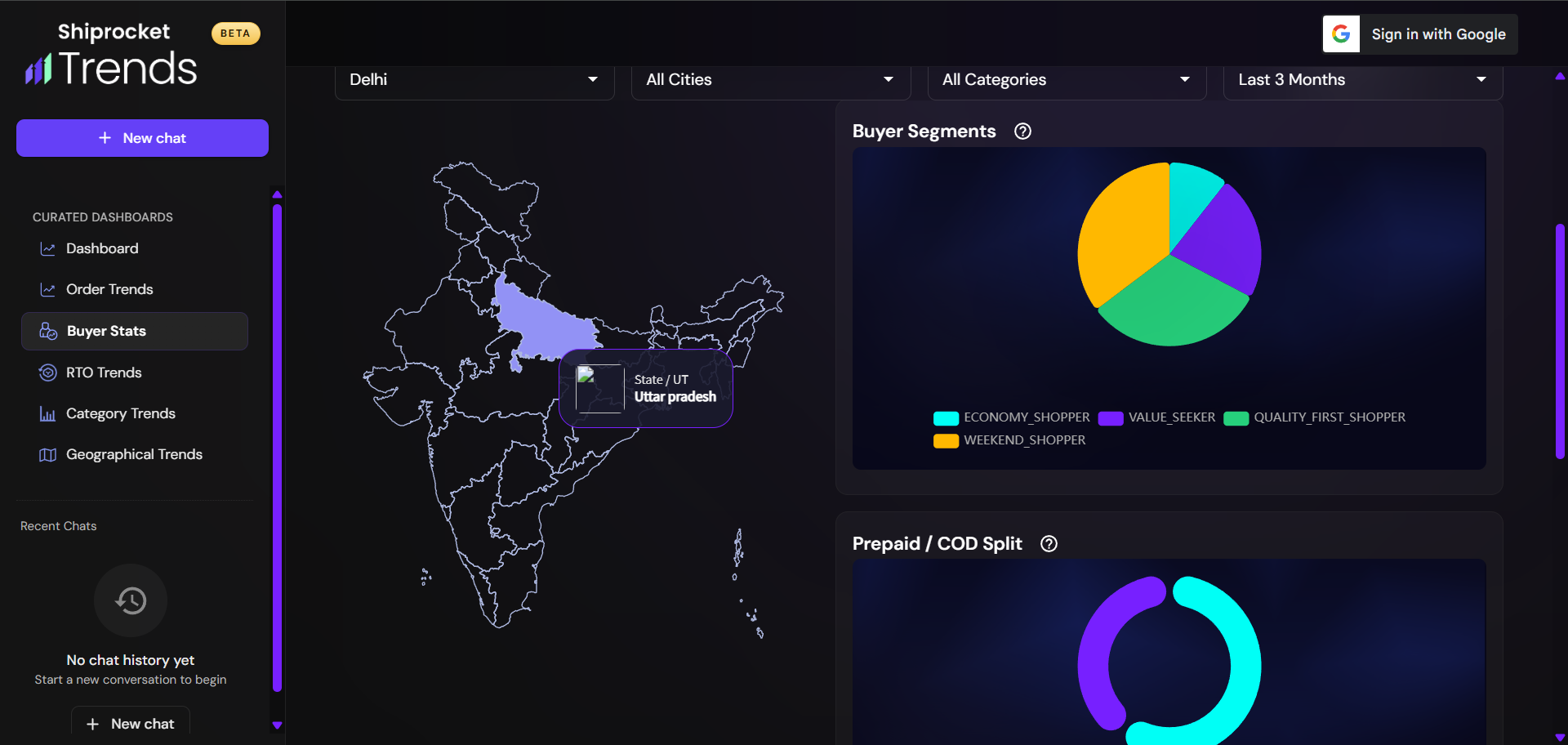
Instead of relying on industry averages, it's always better to track your own data. Tools like Shiprocket Trends help the sellers understand which states and PIN codes are generating the highest RTOs, where delivery issues are happening, and which areas need attention. This makes it easier to take decisions like restricting COD in certain locations or choosing a better courier partner.
 READ MORE: RTO apps for ecommerce in India

DAMINI TRIPATHI
Damini Tripathi, rocking the digital marketing scene for 7 awesome years. Started from scratch, now running my digital marketing agency and creating cool content too. She has been one of the fastest-growing digital marketers on the internet. Damini has also scaled multiple clients from ZERO —> HERO.