There are no items in your cart
Add More
Add More
| Item Details | Price | ||
|---|---|---|---|

If you run an e-commerce brand in India, there’s a high chance you'll feel that drowning feeling in your stomach when you open your dashboard and see yet another “Returned to Origin.”
That three-letter word RTO has ruined more ROAS than bad creatives ever have. It doesn’t matter how good your ads are or how beautifully your product is packaged; when a COD order comes back without reaching the customer, it feels like money just burned itself out of your pocket.
Every marketer knows this pain. Trying to understand why yesterday’s winning campaign suddenly looks like a losing game today.
You double-check your ads, your targeting, your creatives, but the real problem isn’t inside Meta Ads Manager. It’s inside the behaviour of the Indian audience and their mindset.
This is exactly why the struggle feels so real, because you can control your ads, but you can’t control what customers do after placing an order. They forget, they change their mind, they don’t pick up calls, they act surprised when delivery arrives, and some even say, “Oh, I didn’t order anything.
If this cycle feels familiar, trust me, you’re not alone. Every single D2C founder, marketer, and store owner has gone through this exact emotional roller coaster.
And this is where the entire conversation around RTO apps starts to change. Because these are not just “tools.” They’re survival systems for Indian e-commerce.

This is why RTO apps started becoming popular. They don’t try to change customer behaviour; they try to manage it better. They add small filters and small checkpoints that make sure only genuinely interested customers place orders.
Think of them as your store’s personal bodyguards, standing at the entrance and checking who should be allowed in.
Over the last few years, apps like Partially, Split2Ship, COD King, and GoKwik have become almost essential for Indian e-commerce stores.
It’s because they solve very real problems, the kind that keep you awake at night when you see your COD orders piling up with no guarantee of delivery.
The best part? These apps understand exactly how Indian customers think. They know that if you ask a customer to pay ₹49 upfront, the serious ones will do it. They know that OTP verification reduces impulse buying. They know that a fast checkout increases customer trust.
While I could dive deeper here, I’ve already covered -
When Partial COD first came into the scene, many marketers were worried. But surprisingly, Indian customers adapted extremely fast. They didn’t mind paying ₹25 or ₹50 as a token amount because it felt small and safe.
And that tiny payment changed everything for brands. With apps like these, your COD orders suddenly become intentional. People who genuinely want your product go ahead, and the rest automatically drop off.
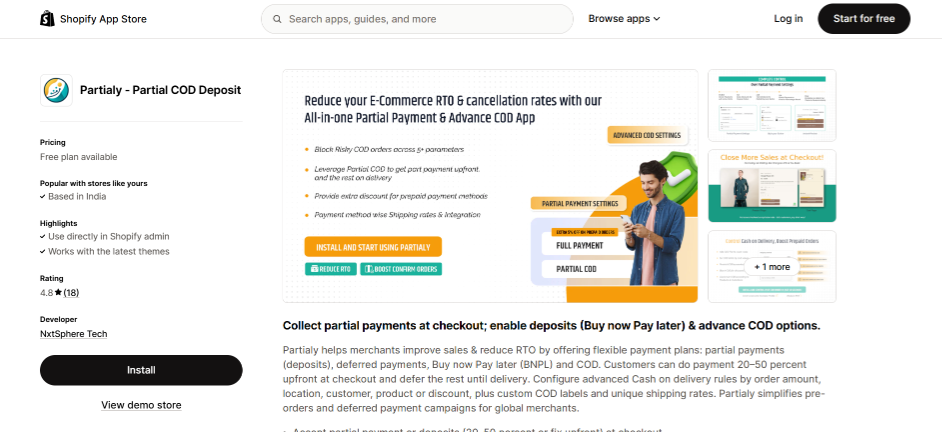
Instead of rejecting your order at delivery, they reject it at checkout, which saves you money. And the best part is that the audience doesn’t feel pressured. They feel like they’re securing their order, not paying for it.
Split2Ship
If there’s one thing Indian buyers love, it's flexibility. They want COD, but they also want trust. This is why apps like Split2Ship work so well. They allow the customer to split the payment, a small part online, and the rest during delivery.

This hybrid model is perfect for Indian e-commerce. It feels safe, it feels modern, and it feels comfortable. Customers don’t feel forced. And brands finally get the assurance they’ve been craving.
I’ve seen several D2C brands double their COD success rate simply by enabling this single feature. When customers make even a tiny payment upfront, the cancellation rate drops dramatically.
COD King
We all know that 2 AM shopper, the one scrolling Instagram, clicking random ads, adding things to cart, and placing COD orders just because it feels easy. By morning, they don’t even remember what they ordered.
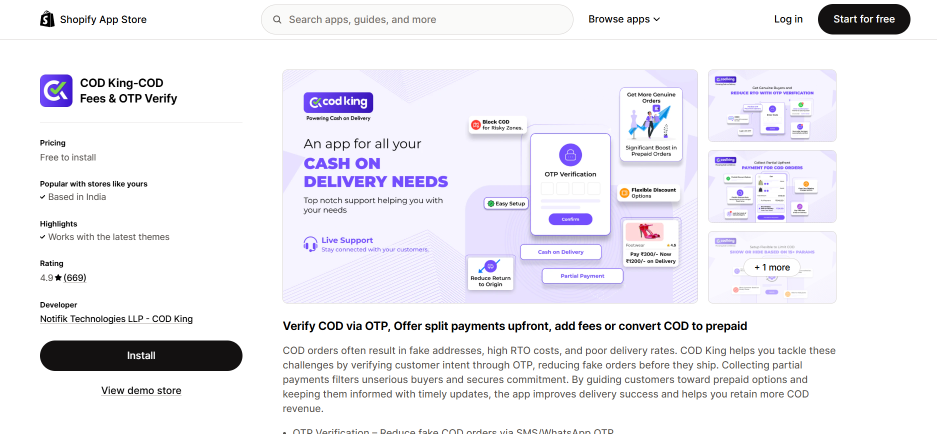
This app helps to resolve the issue simply because options like OTP verification, COD fees, and small points filter out impulsive shopping. When the process requires a little effort, only real customers continue.
And that’s exactly what brands want: authenticity. This is why COD King is one of the most loved RTO control apps in India.
What Most People Do Wrong
The biggest mistake brands make is assuming RTO is only a customer issue. But the truth is, it’s often because brands don’t set up systems to prevent it.
They open COD for everyone, keep checkouts long and confusing, skip verification steps, and never analyse which audience behaves poorly. Instead of fixing the system, they blame the platform. RTO is not an accident; it's the result of a weak process.
How to Use This in Real Life
If you really want these apps to work, you need to treat them like strategic tools, not quick fixes. Start by understanding your audience. Notice who cancels more, who pays more, and who places genuine orders.
Then choose an RTO app that fits your customers’ behaviour. If your audience hates paying full online, go for Partial COD.
If you need flexibility with order management, try this app. If they are impulse shoppers, activate OTP verification. Keep you growing. When you blend these apps with your marketing, your entire e-commerce flow becomes stronger and predictable.
READ MORE: How to Improve Your ROAS Enough to Make Your Competitors Jealous!
RTO will always be a part of Indian e-commerce. You can’t eliminate it, but you can control it smartly. And only those businesses actually succeed that keep trying, testing, and experimenting with new ways and methods. Not those brands that only complain.
At the end of the day, the future of e-commerce in India only belongs to those brands that understand their audience and keep observing and working on their needs and demands.
Make sure to track these things from time to time. Combine them with good creatives and better checkout systems, strong communication, and your COD performance will transform automatically.

DAMINI TRIPATHI
Damini Tripathi, rocking the digital marketing scene for 5 awesome years. Started from scratch, now running my digital marketing agency and creating cool content too. She has been one of the fastest-growing digital marketers on the internet. Damini has also scaled multiple clients from ZERO —> HERO.